
Building a Legacy: How Do You Transform Expertise into “Sovereign Power”?
There is a fundamental distinction between professional success and enduring institutional impact. Professional success is generally measured through identifiable outcomes: the position attained, the decisions implemented, the objectives achieved, the reputation accumulated, or the financial and organizational results produced during a period of responsibility. Legacy operates according to a different logic. It concerns what remains capable of influencing decisions, people, standards, and institutions after the individual who generated that influence is no longer present. This distinction is consistent with the broader leadership literature, which increasingly treats leadership not merely as the exercise of authority but as a process through which people, organizational capabilities, and collective purposes are developed over time (Northouse, 2021). In Good to Great, Collins similarly distinguishes leadership that is centered on the individual from leadership directed toward the enduring interests of the organization, arguing that Level 5 leaders combine “personal humility” with “professional will” and channel ambition toward the institution rather than toward themselves (Collins, 2001, pp. 21–22). The question for the senior executive, diplomat, institutional leader, or strategic adviser is therefore not simply whether they have succeeded while occupying a particular position, but whether the value they created can continue to operate after the position itself has disappeared.
Legacy should consequently not be understood as something constructed during the final stage of a professional career. It is a cumulative institutional process that begins whenever responsibility is assumed. Every significant decision establishes a precedent; every appointment affects institutional capability; every response to failure communicates a standard; every method of solving a complex problem creates a potential model for others; and every relationship managed with integrity contributes to the reputational architecture of the institution. Senge’s conception of the learning organization is particularly relevant here because he argues that organizations must develop the capacity to learn collectively rather than depend upon a single individual who possesses the answers. As he writes, “organizations learn only through individuals who learn. Individual learning does not guarantee organizational learning. But without it, no organizational learning occurs” (Senge, 2006, p. 135). The implication for executive leadership is profound: expertise acquires its greatest institutional value when it ceases to remain exclusively personal and becomes capable of generating learning in others.
Within this framework, Sovereign Power is used here as a strategic consulting concept rather than as a conventional academic term. It does not refer to political sovereignty, governmental authority, or the legal power of a sovereign state. It describes the higher-order form of professional influence that emerges when an individual’s knowledge, judgment, principles, methodology, and ethical standards become sufficiently credible and transferable to continue influencing institutional behaviour beyond the individual’s formal authority. The concept therefore sits at the intersection of leadership, organizational learning, succession, knowledge transfer, institutional culture, and long-term strategic influence (Collins, 2001; Kotter, 1996; Senge, 2006; Sinek, 2019). The transformation is complete when personal expertise has become institutional capability: when others can exercise better judgment because of what the leader taught, when successors can continue a methodology without requiring permanent supervision, and when principles introduced by one leader remain embedded in practice after that leader has departed.
What Is Sovereign Power?

Conventional organizational power is closely associated with formal authority. An executive occupies a position, controls resources, possesses decision rights, and exercises legitimate influence over institutional outcomes. Such authority is indispensable to functioning organizations, but it remains structurally dependent upon the office. When the individual leaves the position, much of the formal power necessarily transfers to the successor. Influence based upon credibility, however, operates differently. It can survive organizational restructuring because it is carried within relationships, knowledge, standards, intellectual frameworks, and institutional memory rather than being contained exclusively within an organizational chart (Northouse, 2021).
This distinction is visible in Collins’s analysis of Level 5 leadership. The Level 5 leader is not presented as an individual who seeks to make the organization permanently dependent upon personal charisma. Rather, Collins emphasizes the leader’s orientation toward the organization and its future, including the importance of creating conditions for continued success beyond the leader’s own tenure. His description of the Level 5 leader is particularly revealing: “Level 5 leaders look out the window to apportion credit to factors outside themselves” while looking “in the mirror to apportion responsibility” when things go wrong (Collins, 2001, p. 35). The principle is more than an observation about humility. It suggests a conception of leadership in which the institution, rather than the personality of the leader, becomes the primary object of stewardship.
Sovereign Power therefore emerges when the individual becomes less necessary to the continuation of the value they created. This may appear paradoxical. A highly influential leader might initially believe that maintaining indispensability demonstrates exceptional authority. Yet institutional maturity produces the opposite conclusion. If an institution cannot function without the leader’s constant intervention, the leader may possess extraordinary personal influence while having failed to convert that influence into organizational resilience. The more demanding achievement is to create people, systems, principles, and intellectual resources capable of functioning without continuous personal supervision. Leadership reaches a higher order when the contribution survives the departure of its creator.
Influence Is Not Yet Legacy
Influence and legacy should not be treated as interchangeable concepts. Influence concerns the capacity to affect decisions, perceptions, behaviour, or institutional direction in the present. Legacy concerns the continuation of that influence through other people, organizational practices, intellectual frameworks, and cultural standards after the original source of influence is no longer present. A senior executive may therefore dominate an institution during a particular tenure and yet leave little durable intellectual or organizational trace. Another leader may appear less personally dominant while establishing systems, developing successors, transferring knowledge, and strengthening institutional learning in ways that continue long after departure.
The distinction becomes particularly important when leadership is viewed through the perspective of organizational learning. Senge argues that a learning organization is one in which people continually expand their capacity to create desired results and develop “new and expansive patterns of thinking” (Senge, 2006, p. 6). The significance of this proposition for executive legacy is considerable. If the leader remains the exclusive source of sophisticated judgment, the organization has accumulated dependence rather than learning. If the leader increases the capacity of others to think, interpret, decide, and act, the organization has acquired an asset that can continue to generate value.
The decisive question is therefore not simply, How many people depend upon my judgment today? It is, How many people will be capable of exercising sound judgment because I invested in their development? That question transforms the meaning of executive influence. Personal authority becomes less important than institutional capability; personal recognition becomes less important than transferable knowledge; and immediate dependence becomes less important than long-term resilience. In this sense, the most mature form of leadership is not the preservation of indispensability but the deliberate creation of successors who can carry responsibility further.
Expertise That Remains Unrecorded Is Expertise That Remains Fragile

One of the most persistent vulnerabilities within senior institutional environments is the concentration of critical knowledge in individuals. Experienced executives, diplomats, negotiators, advisers, and institutional leaders often possess forms of knowledge that cannot be found in formal manuals: an understanding of how a particular partner behaves under pressure, why a particular negotiation failed years earlier, which institutional relationship requires unusual care, how a crisis should be interpreted before it becomes public, or which apparently minor signal indicates a significant change in the environment. Much of this knowledge remains tacit rather than formally documented.
The problem is not simply that tacit knowledge is difficult to archive. The deeper problem is that institutions can confuse the preservation of information with the preservation of judgment. A file can record what decision was taken; it may not explain why competing alternatives were rejected, what assumptions were considered unreliable, or what contextual factors made the decision appropriate at the time. Knowledge transfer therefore requires deliberate articulation, reflection, teaching, documentation, and institutional practice. Senge’s learning-organization framework is useful precisely because it emphasizes the movement from individual learning toward collective capability (Senge, 2006).
This is also where the idea of legacy intersects with succession. The objective is not to reduce sophisticated expertise to mechanical instructions. Rather, the objective is to expose the reasoning underlying expert judgment so that others can examine it, challenge it, adapt it, and eventually improve it. A strategic methodology, leadership framework, negotiation protocol, institutional case study, teaching programme, written body of work, or decision-making architecture can convert accumulated experience into an intellectual asset. What is articulated can be examined; what is examined can be taught; what is taught can be transmitted; and what is transmitted can become institutional capability.
Do Not Build an Audience. Build a School of Thought.
The contemporary digital environment has made professional visibility considerably easier to obtain. Executives can publish regularly, accumulate followers, establish personal brands, and generate continuous commentary without necessarily producing a coherent intellectual contribution. Visibility, however, is not synonymous with legacy. An audience follows a person; a school of thought engages with ideas.
The distinction is consistent with the broader conception of leadership as a process of influencing people toward shared objectives rather than merely attracting attention to the leader (Northouse, 2021). A genuine intellectual contribution requires conceptual consistency, evidence, application, intellectual discipline, and the capacity to withstand criticism. The objective for a senior leader should therefore not simply be to become recognizable but to develop a coherent body of thinking that others can examine and extend.
Senge’s work provides a particularly useful foundation for this proposition because learning becomes organizationally significant when knowledge is not merely possessed but incorporated into collective capacity. His description of learning organizations emphasizes the development of “people’s commitment and capacity to learn at all levels in an organization” (Senge, 2006, p. 7). The same principle can be applied to executive intellectual influence. A body of ideas becomes genuinely durable when other serious professionals can use it, challenge it, teach it, refine it, and apply it to circumstances beyond those originally contemplated by its creator.
For the executive, diplomat, or strategic adviser, the relevant question therefore changes from How can I increase my visibility? to What proposition do I want my professional contribution to represent? A coherent philosophy of leadership, institutional governance, negotiation, strategic communication, diplomacy, executive presence, or crisis management can become an intellectual signature. When that signature is demonstrated consistently through professional conduct, research, teaching, writing, and institutional practice, expertise begins to acquire a life beyond the individual.
Values Are the Infrastructure of Legacy
Institutional legacy is often discussed through achievements, strategies, financial results, and organizational growth. Yet the most durable dimension of leadership may be considerably less visible: the standards that become normalized through repeated behavior. Organizations do not inherit only policies from their leaders; they inherit expectations concerning how people behave when those policies are tested.
This is closely connected to Edmondson’s work on psychological safety. In The Fearless Organization, Edmondson argues that high-performing knowledge environments require conditions in which individuals can raise concerns, questions, mistakes, and ideas without being unnecessarily silenced or humiliated (Edmondson, 2018). The implication for legacy is significant. A leader’s response to disagreement becomes part of the behavioral environment experienced by everyone else. If dissent is consistently punished, employees learn that silence is safer than contribution. If disagreement can be expressed seriously and respectfully, the institution develops a different form of intellectual capacity.
Values become institutional when they are repeatedly demonstrated rather than merely announced. The way a leader distributes credit, responds to failure, handles confidential information, treats junior colleagues, manages disagreement, and accepts responsibility establishes a practical standard for others. Over time, repeated behaviour becomes cultural expectation. This is why institutional legacy cannot be manufactured through a final speech, commemorative statement, or carefully designed succession announcement. It is created through repetition.
Collins’s “window and mirror” principle reinforces the same point from another direction. The Level 5 leader does not construct a personal mythology around success; instead, success is attributed outward while responsibility for failure is accepted personally (Collins, 2001, p. 35). Such conduct communicates a standard that can become culturally reproducible. The leader’s values become organizational values not because the leader announces them, but because other people repeatedly observe them in action.
The Highest Form of Leadership Is the Creation of Other Leaders
There is a powerful temptation among accomplished professionals to preserve their indispensability. Expertise produces status, and status can become attached to being the person who possesses the answer, maintains the critical relationship, resolves the crisis, or carries the institutional memory. Yet, from the perspective of succession, this form of indispensability can represent an institutional weakness rather than the highest form of leadership.
The more demanding achievement is to create people capable of exercising judgment independently. This requires more than delegation. It requires progressive responsibility, exposure to complexity, constructive criticism, opportunities to make consequential decisions, and the willingness to permit capable people to develop approaches that differ from those of the original leader. The leader must eventually accept that successors may surpass them in particular areas of expertise. That is not a failure of authority; it is evidence that authority has been transformed into capability.
Collins makes the succession dimension explicit in his characterization of Level 5 leadership: Level 5 leaders “set up their successors for even greater success in the next generation” (Collins, 2001, p. 39). This principle should be treated as central to any serious theory of executive legacy. A leader who solves one hundred problems personally has produced one hundred solutions. A leader who develops ten capable decision-makers has potentially created an institutional system capable of solving thousands of future problems without requiring the original leader’s intervention.
The multiplication effect is therefore fundamental. Personal expertise operates linearly when it remains attached to the individual. Institutional expertise becomes multiplicative when it is transferred through people. This is why succession should not be treated as an administrative event occurring shortly before departure. It should be understood as the continuous process through which leadership capability is reproduced.
Legacy in the Age of Artificial Intelligence
The rise of artificial intelligence makes the question of expertise more rather than less important. As AI systems increasingly assist with information retrieval, synthesis, pattern recognition, analysis, drafting, and knowledge production, access to information becomes less scarce. The comparative value of leadership consequently shifts toward judgment: determining which information matters, how competing evidence should be interpreted, what principles should guide its application, and where ethical or institutional boundaries should be drawn.
The Future of Jobs Report 2025 provides a useful contemporary indicator of this changing capability landscape. The World Economic Forum identifies analytical thinking as the leading core skill among employers surveyed, followed by resilience, flexibility and agility, and leadership and social influence; empathy and active listening also appear among the ten most frequently identified core skills (World Economic Forum, 2025, p. 35). These findings are important because they complicate any simplistic opposition between technical expertise and human capability. The emerging institutional environment requires both technological competence and sophisticated human judgment.
This development strengthens rather than weakens the argument for intellectual legacy. If technology increasingly reduces the scarcity of raw information, the distinctive contribution of senior leadership lies increasingly in frameworks for interpreting information responsibly. The leader who merely possesses information may become progressively less differentiated. The leader who develops a distinctive methodology for thinking, deciding, teaching, governing, negotiating, and managing uncertainty can become more valuable precisely because that methodology gives structure to abundant information.
Sinek’s concept of the “infinite game” offers a complementary perspective. He argues that organizations operating with an infinite mindset must orient themselves toward a future that extends beyond individual finite objectives and develop practices that sustain the organization over time (Sinek, 2019). His concept of a “Just Cause” is particularly relevant because he defines it as “a specific vision of a future state that does not yet exist” (Sinek, 2019, p. 39). Legacy can be understood within the same temporal logic: the leader’s responsibility is not merely to maximize the results of the current period but to create conditions under which the institution can continue developing after the leader’s participation has ended.
Legacy Begins Long Before Departure
One of the most consequential misconceptions concerning legacy is that it belongs to the final stage of a career. The possibility of legacy is established through decisions made decades before anyone begins discussing succession. Every professional relationship represents a potential transmission of knowledge; every junior colleague represents an opportunity for development; every difficult decision establishes a precedent; every institutional reform creates a potential future standard; and every crisis reveals what the leader is prepared to defend when those standards become costly.
Senge’s formulation of organizational learning is particularly important here because it moves the discussion away from the preservation of individual expertise and toward the continuous expansion of collective capacity. The learning organization is not simply an organization containing knowledgeable individuals; it is one in which people continually expand their capacity to create desired results (Senge, 2006, p. 6). Legacy therefore begins whenever the leader deliberately asks whether an experience will remain merely personal or whether it can become a source of learning for others.
Kotter’s work on organizational change reinforces the temporal dimension. Leading Change emphasizes that successful transformation requires more than managerial coordination; it requires leadership capable of establishing direction, communicating vision, mobilizing people, and institutionalizing new approaches (Kotter, 1996). The final stage embedding new approaches within the organization is particularly relevant to legacy because it represents the movement from an individual’s initiative toward an enduring institutional practice.
The leader who understands this begins to operate differently from the beginning. They ask not only whether a decision solves the immediate problem, but whether it establishes a principle worth preserving. They ask not merely whether a colleague has completed a task, but whether the experience has increased that person’s capacity. They ask not merely whether the institution is succeeding today, but whether the systems being created will remain effective under different leadership tomorrow.
From Private Expertise to Public Value
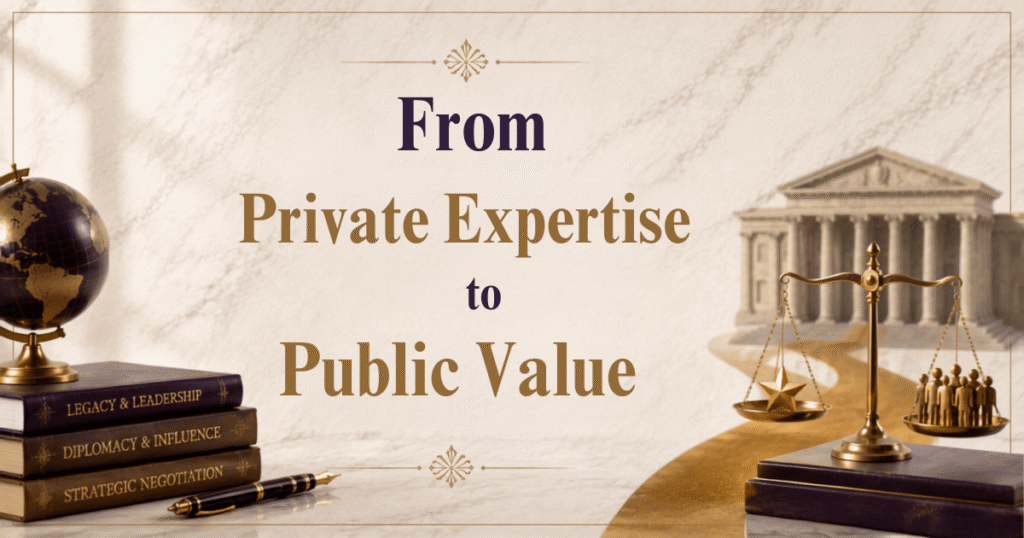
The deepest transformation occurs when expertise ceases to function exclusively as personal capital and becomes a resource that benefits institutions, professional communities, and future generations. The diplomat who teaches younger practitioners, the executive who develops successors, the strategist who documents a methodology, and the institutional leader who creates systems capable of surviving succession are all converting private experience into institutional value.
This movement from private expertise toward collective capability is central to Senge’s conception of organizational learning. Knowledge becomes organizationally meaningful when it contributes to the capacity of people throughout the institution rather than remaining concentrated in one individual (Senge, 2006). Edmondson’s research similarly emphasizes the importance of environments in which people can raise questions, identify mistakes, and contribute knowledge without excessive interpersonal risk (Edmondson, 2018). A leader who creates such an environment does not merely distribute information; they create the conditions under which institutional intelligence can expand.
There is therefore an ethical dimension to senior expertise. Exceptional professional knowledge carries a responsibility to be transmitted rather than merely accumulated. The value of a distinguished career is not exhausted by the achievements that appear on a résumé. Its deeper value may lie in what other people become capable of doing because the individual chose to teach, document, mentor, challenge, and institutionalize what they had learned.
This is the distinction between expertise that terminates with its owner and expertise that becomes generative. The first may produce achievement. The second has the capacity to produce institutional history.
The Infinite Horizon of Institutional Legacy
Sovereign Power also requires a different understanding of time. Contemporary executive environments frequently reward measurable short-term performance, yet durable institutions depend upon decisions whose full value may become visible only years later. Sinek’s distinction between finite and infinite games provides a useful conceptual vocabulary for this problem. An organization operating with an infinite mindset is not primarily concerned with producing a final victory; it is concerned with sustaining the capacity to continue advancing toward a meaningful future (Sinek, 2019).
This perspective changes the meaning of executive achievement. A leader who optimizes only for immediate recognition may produce impressive short-term results while weakening the institution’s capacity for future adaptation. A leader who develops people, preserves institutional memory, strengthens systems, and establishes principles capable of surviving changing circumstances may produce less visible personal recognition while creating considerably greater long-term value.
Sinek’s formulation of the Just Cause is particularly relevant because he emphasizes that it concerns a future state that does not yet exist and that individuals may make sacrifices to advance toward it (Sinek, 2019, pp. 39–40). The parallel with legacy is not that every executive requires a grand ideological mission. It is that serious leadership requires an orientation toward something that extends beyond the immediate self. The executive who thinks only in terms of personal tenure cannot easily create an institution designed to outlast that tenure.
Legacy therefore demands an institutional horizon longer than the individual’s career.
What Remains When the Name Is Removed?

Ultimately, the durability of leadership cannot be measured exclusively through the length of a tenure, the size of an organization, the number of awards received, the visibility of a personal brand, or the financial results generated during a particular period. These indicators may describe professional success, but they do not fully answer the more demanding question of institutional legacy.
The more consequential questions are different. Did the leader leave behind stronger people? Did their ideas become coherent enough to survive without their physical presence? Did their standards influence institutional culture? Did their methodology improve subsequent decisions? Did the institution become more resilient because they had been there? Did successors inherit greater capability rather than merely inherited procedures? And, perhaps most importantly, can the value of the contribution still be recognized when the leader’s name is removed from it?
This is the point at which the consulting concept of Sovereign Power becomes analytically useful. The concept describes the transition from authority that belongs to a position toward influence that survives because it has been embedded in people, principles, knowledge, culture, and institutional practice. It is not sovereign because the individual possesses power over others. It is sovereign because the value of the contribution becomes increasingly independent of the original source of authority.
Collins’s Level 5 framework provides a powerful academic counterpoint to personality-centered leadership because the leader’s ambition is directed toward the organization rather than toward personal glorification (Collins, 2001). Senge provides the organizational-learning dimension by showing why individual learning must become collective capability (Senge, 2006). Kotter provides the institutional-change dimension by emphasizing the importance of embedding new approaches rather than merely announcing them (Kotter, 1996). Edmondson contributes the human and cultural dimension by demonstrating why people must feel sufficiently safe to contribute knowledge, questions, concerns, and dissent (Edmondson, 2018). Sinek contributes the temporal dimension by emphasizing leadership oriented toward a future that extends beyond finite victories (Sinek, 2019). Taken together, these perspectives provide a strong conceptual foundation for understanding why enduring leadership is ultimately measured through what continues after the leader’s direct presence has ended.
The highest expression of leadership is therefore not to make an institution permanently dependent upon one’s presence. It is to make one’s contribution sufficiently deep that the institution becomes stronger precisely because one was once there. A leader’s most enduring presence may ultimately be found not in the room they occupied, but in the quality of judgment exercised by those they developed, the standards upheld by those who succeeded them, the systems that continue to function, and the ideas that remain useful after the original circumstances have disappeared.
That is the transition from expertise to Sovereign Power: when what you know becomes what others can carry; when what you have learned becomes what an institution can teach; when the principles you defended become standards others uphold; and when your influence no longer requires your physical presence to remain institutionally alive.
References
- Collins, J. C. (2001). Good to Great: Why Some Companies Make the Leap… and Others Don’t. HarperBusiness.
- Edmondson, A. C. (2018). The Fearless Organization: Creating Psychological Safety in the Workplace for Learning, Innovation, and Growth. Wiley.
- Kotter, J. P. (1996). Leading Change. Harvard Business School Press.
- Northouse, P. G. (2021). Leadership: Theory and Practice (9th ed.). SAGE Publications.
- Senge, P. M. (2006). The Fifth Discipline: The Art and Practice of the Learning Organization (Rev. and updated ed.). Doubleday/Currency.
- Sinek, S. (2019). The Infinite Game. Portfolio.
- World Economic Forum. (2025). The Future of Jobs Report 2025. World Economic Forum.
- Harvard Business Review. (n.d.). Research and practitioner literature on leadership, succession, organizational culture, and institutional knowledge.
- MIT Sloan Management Review. (n.d.). Research on leadership, organizational learning, knowledge transfer, and institutional resilience.