
Stakeholder Intelligence: How to Map Influence Before Negotiations Begin?
In complex negotiations, the visible interaction at the negotiating table represents only one part of the decision-making process. The individuals seated across from one another may possess formal authority, technical expertise, or responsibility for conducting the discussion, yet the eventual outcome is frequently shaped by actors who are not present in the room. Boards, legal advisers, regulators, technical specialists, political authorities, institutional partners, influential colleagues, clients, investors, and other constituencies may each possess the capacity to facilitate, constrain, delay, reinterpret, or ultimately prevent an agreement. This broader understanding is consistent with the foundational stakeholder framework developed by Freeman, who defined a stakeholder as “any group or individual who can affect, or is affected by, the achievement of a corporation’s purpose” (Freeman, 1984, p. 25). The significance of this definition is precisely that it moves managerial attention beyond the immediate negotiating counterpart and toward the wider institutional environment within which an agreement must ultimately function.
For executive leadership, this distinction has profound practical consequences. Negotiation preparation is frequently understood in terms of objectives, concessions, arguments, alternatives, and presentation strategy. These elements remain essential, but they address only the substantive dimension of the negotiation. Equally important is understanding the institutional environment within which the decision will be made. A negotiator who understands the proposal but misunderstands the decision architecture may prepare an excellent argument for a person who does not possess the authority to accept it or may overlook an actor whose reservations can determine the outcome. Freeman’s stakeholder framework is particularly relevant here because it emphasizes not merely the identification of stakeholders but the management of relationships and the processes through which those relationships affect organizational purpose (Freeman, 1984). Stakeholder intelligence therefore begins with a deceptively simple question: who can alter the trajectory of the decision, through which mechanism, under what circumstances, and with what interests at stake?
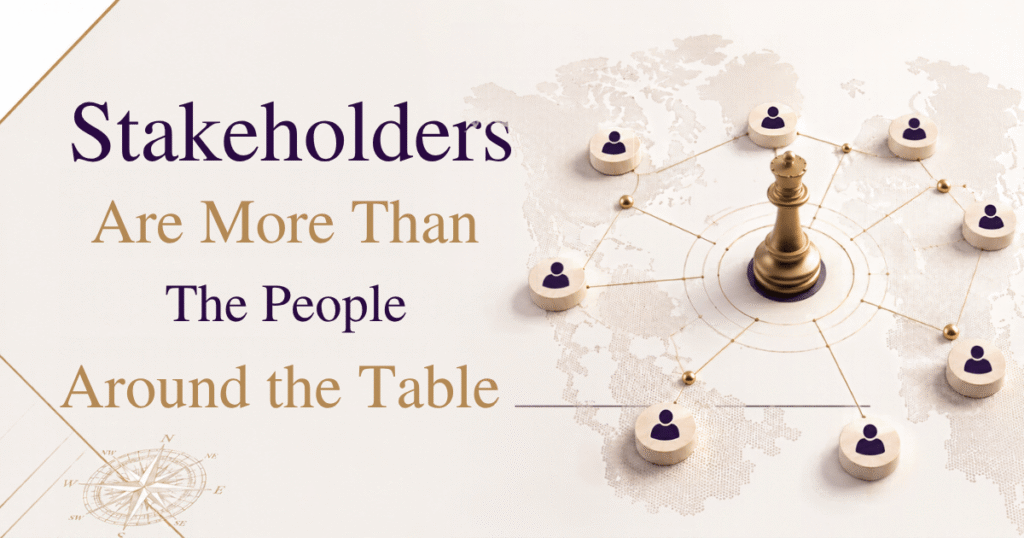
Stakeholders Are More Than the People Around the Table
The term stakeholder is sometimes used narrowly to describe shareholders, investors, clients, or formally designated project participants. In institutional negotiations, such a definition is insufficient. Freeman’s original formulation deliberately encompasses a much wider field, including employees, customers, suppliers, stockholders, banks, environmental groups, government, and other actors capable of helping or hindering the corporation (Freeman, 1984, p. 25). The importance of this broader perspective lies in the distinction between interest and influence. An individual may have a substantial interest in the outcome while possessing little capacity to alter it. Another may appear to have only a peripheral interest while possessing considerable influence because decision-makers rely upon their technical judgment, institutional memory, professional credibility, or access to senior authority.
The stakeholder perspective therefore should not be reduced to an inventory of names and titles. Freeman explicitly notes that even the broad stakeholder map is “enormously oversimplified” because each category can itself be divided into more meaningful subcategories (Freeman, 1984, p. 25). This observation remains highly relevant to contemporary executive practice. A government authority, for example, is not a single homogeneous stakeholder; neither is a board, a legal department, a technical function, an investor group, or a strategic partner. Each contains different interests, responsibilities, incentives, and degrees of influence. The purpose of stakeholder mapping is consequently to reveal the relationships between those dimensions rather than merely to enumerate participants.
This becomes particularly important in international and institutional negotiations, where the person conducting the negotiation may not be the person ultimately capable of approving the agreement. A negotiator can therefore achieve apparent success in the meeting while having failed to secure the conditions necessary for implementation. The subsequent delay, objection, or rejection may appear irrational only because the underlying decision architecture was never properly understood.
Formal Authority and Informal Influence Are Not the Same
Organizational charts provide valuable information, but they rarely provide a complete representation of how decisions occur. Formal structures identify reporting relationships, responsibilities, and positions within an institution; they do not necessarily reveal patterns of trust, expertise, access, professional dependency, or informal authority. Stakeholder theory is useful precisely because it encourages the executive to examine the organization as a network of relationships rather than merely as a hierarchy of offices (Freeman, 1984; Freeman, Harrison, Wicks, Parmar, & de Colle, 2010).
A general counsel, for example, may possess the practical capacity to prevent an agreement from proceeding because of legal or regulatory concerns. A technical adviser may determine whether an executive proposal is considered operationally credible. A long-serving senior official may possess institutional memory that allows them to identify risks invisible to newly appointed decision-makers. A deputy may exercise disproportionate influence because of an established relationship of trust with the principal. None of these forms of influence necessarily appears on an organizational chart.
The executive negotiator must therefore distinguish between formal authority and effective influence. Formal authority answers the question of who has the legitimate right to decide. Stakeholder intelligence asks the more sophisticated question of who shapes the information, assumptions, risk assessments, and legitimacy upon which that decision depends. This distinction is particularly important because institutional decisions are rarely produced by authority acting in isolation; they emerge through processes of consultation, expertise, accountability, and relationship
The Influence Architecture Behind the Decision

Before entering an important negotiation, a disciplined leader should construct an influence map that goes beyond identifying supporters and opponents. The relevant questions concern the architecture of the decision itself: who benefits from the proposed outcome, who bears its risks, who may be held accountable for its consequences, who possesses the authority to approve it, who can delay it, who can veto it, who can provide indispensable expertise, and whose support would confer legitimacy upon the decision. Freeman’s stakeholder framework is particularly valuable here because it encourages managers to understand not only who the stakeholders are but also the processes through which relationships with them are managed (Freeman, 1984).
Influence must also be considered temporally. Some stakeholders matter primarily during the initial evaluation of a proposal, while others become decisive during implementation. A regulator may have limited relevance to the commercial discussion itself but become critically important at the approval stage. A financial partner may support a strategic concept but impose conditions that materially alter its feasibility. An internal executive may initially remain neutral but become influential once responsibility for implementation is assigned. Stakeholder influence is consequently neither static nor uniform; it changes according to the stage of the decision, the issue under discussion, the level of uncertainty, and the distribution of perceived risk.
This is why an influence map should be treated as a living analytical instrument rather than a fixed diagram prepared once and then forgotten. The objective is not merely to know who matters today, but to anticipate who will matter when the decision moves from negotiation to approval, from approval to implementation, and from implementation to accountability
Not Every Influential Person Is Your Opponent
Certain negotiators commit the error of treating anyone who raises difficult questions as an adversary.
Yet, questions are not always resistance.
Sometimes, they represent an attempt to comprehend risk.
Occasionally, they reflect professional responsibility.
And at times, they serve as a mechanism to safeguard the institution.
Therefore, diplomatic intelligence demands distinguishing between:
- Those who oppose the concept.
- Those who oppose the execution method.
- And those who merely require further information.
Each category demands a distinct mode of dialogue.
Not Every Difficult Stakeholder Is an Opponent
One of the most damaging assumptions in negotiation is that resistance automatically indicates opposition. An individual who asks demanding questions, requests additional evidence, or challenges the assumptions underlying a proposal may not be attempting to obstruct the initiative. They may be fulfilling a professional responsibility, protecting the institution from an identifiable risk, or attempting to ensure that the decision can withstand subsequent scrutiny. Treating responsible scrutiny as hostility can therefore transform a potentially constructive relationship into an unnecessary conflict.
This principle connects directly with the interest-based negotiation tradition of Fisher, Ury, and Patton. Their central proposition is that negotiators should distinguish positions from the interests that generate them: “Your position is something you have decided upon. Your interests are what caused you to so decide” (Fisher, Ury, & Patton, 2011, pp. 42–43). The distinction is strategically powerful because it changes the question asked by the negotiator. Instead of asking why an individual is being difficult, the leader asks what responsibility, concern, risk, or institutional principle is producing the resistance.
A legal adviser may therefore appear obstructive because their professional responsibility requires them to identify liabilities. A technical expert may repeatedly challenge an optimistic proposal because they will ultimately bear responsibility for its operational consequences. A senior official may resist an apparently attractive initiative because it conflicts with a broader strategic commitment established by the institution. Once the underlying interest becomes visible, the apparent opposition may become substantially more intelligible.
Analyse Interests Before Personalities

Negotiators often prepare psychological profiles of their counterparts, attempting to determine whether someone is rigid or flexible, cautious or ambitious, confrontational or accommodating. Such observations can occasionally be useful, but they are insufficient without an understanding of the interests that structure the person’s decisions. A cautious executive may not be personally resistant to a proposal; they may be accountable for protecting institutional resources. A technical director may not be pessimistic by temperament; they may simply understand operational risks that others have not yet considered.
The distinction between personality and institutional interest is fundamental because personality-based analysis can easily become speculative, whereas responsibility-based analysis can be investigated. Fisher, Ury, and Patton’s approach is particularly instructive because it directs attention away from the visible position toward the underlying concerns that generate it (Fisher et al., 2011). Their formulation that “interests motivate people” captures the analytical principle at the centre of sophisticated negotiation preparation: the visible statement is often only the surface expression of a deeper institutional requirement (Fisher et al., 2011, pp. 42–43).
The central question consequently becomes not “What position does this person hold?”, but “What responsibility, interest, risk, or principle explains why this position matters to them?” That question is more demanding, but it is also more strategically useful because it creates the possibility of addressing the source of resistance rather than merely attempting to overcome its expression.
Informal Influencers and Institutional Memory
Every mature institution contains individuals whose influence exceeds their formal position. Some possess exceptional technical competence; others have accumulated decades of institutional memory. Some enjoy unusual access to senior leadership, while others function as trusted interpreters between different organizational constituencies. Their influence may be invisible precisely because it has become normalized.
Ignoring these actors can create significant strategic risk. A negotiator may secure formal approval from senior leadership while failing to understand the reservations of the technical or legal professionals responsible for implementation. The agreement may therefore encounter resistance not because the executive decision was reversed, but because the operational environment was never adequately considered.
Informal influence should not, however, be interpreted automatically as hidden manipulation. In many institutions it represents accumulated professional trust. Freeman’s stakeholder approach is useful here because it treats organizational relationships as substantive components of strategic management rather than as peripheral social dynamics (Freeman, 1984). Similarly, Freeman et al. emphasize the importance of understanding the relationships through which stakeholders and organizations interact, rather than treating stakeholder groups as isolated categories (Freeman et al., 2010). The objective is therefore not to discover a mysterious “power behind the power,” but to understand how legitimate institutional judgments travel.
Influence Operates as a Network

Decision-making is often represented as a linear process in which information moves upward, decisions move downward, and implementation follows. Complex institutions rarely operate so neatly. Influence can move in multiple directions simultaneously: technical expertise can influence executive judgment; regulatory requirements can alter commercial strategy; client expectations can influence board decisions; and public concerns can affect institutional priorities. Stakeholder theory’s broader contribution is precisely to move managerial analysis away from a narrow conception of the firm and toward a relational understanding of the organization and its environment (Freeman, 1984; Freeman et al., 2010).
This networked character of influence means that a stakeholder’s importance cannot always be assessed independently. What matters may be the relationship between actors. An adviser may have limited influence in isolation but considerable influence because they possess direct access to a powerful decision-maker. A professional association may have little formal authority but substantial legitimacy within a particular policy environment. A technical department may lack approval authority but possess information without which executive leadership cannot responsibly proceed.
The resulting picture is therefore closer to an influence ecosystem than a hierarchy. The sophisticated negotiator does not simply ask who sits above whom. They ask who speaks to whom, whose judgment is trusted, whose approval is necessary, whose objections carry institutional weight, and whose support changes the perceived legitimacy of the final decision.
Stakeholder Intelligence Begins Before the First Meeting
The most valuable stakeholder intelligence is rarely generated during the negotiation itself. By the time the parties enter the room, much of the relevant institutional landscape should already have been investigated. This preparation may include annual reports, official statements, regulatory frameworks, previous agreements, institutional histories, leadership priorities, public commitments, strategic plans, previous disputes, and publicly available evidence concerning the organization’s current objectives.
The purpose of this preparation is not to accumulate information indiscriminately. It is to construct a coherent interpretation of the environment in which the decision will occur. Freeman’s original framework already distinguishes between identifying stakeholders and understanding the processes through which organizations manage relationships with them (Freeman, 1984). Stakeholder intelligence extends this logic into executive preparation: information becomes strategically useful when the leader can connect facts to institutional interests, responsibilities, relationships, and decision mechanisms.
A leadership statement may reveal a strategic priority; a previous transaction may reveal an institutional constraint; a regulatory development may explain a recent change in position; and a personnel change may alter the distribution of influence. Preparation therefore consists not of collecting more data, but of developing a more accurate model of the decision environment.
Do Not Attempt to Persuade Everyone

A common inefficiency in stakeholder engagement is the assumption that every stakeholder should receive the same level of attention and persuasion. Stakeholders perform different functions within a decision system. Some possess approval authority; others possess veto power; others provide expertise; some confer legitimacy; others are responsible for implementation; and some require information primarily because their cooperation is necessary for execution.
An influence map enables leadership to differentiate these functions and allocate attention accordingly. The objective is not to communicate less, but to communicate with greater precision. A board may require strategic and financial assurance. A legal team may require evidence of compliance and risk mitigation. A technical team may require operational clarity. A strategic partner may require confidence regarding mutual value. Treating all of these audiences identically would represent a failure of stakeholder intelligence rather than an expression of transparency.
The most sophisticated stakeholder strategy therefore aligns the message, timing, level of detail, and engagement method with the legitimate role of each stakeholder in the decision process. This is consistent with Freeman’s broader proposition that effective stakeholder management requires attention to the relationships and transactions through which organizational purpose is pursued (Freeman, 1984).
Influence Mapping Is Not Manipulation
Because the language of influence can easily be misunderstood, an important ethical distinction must be established. Stakeholder intelligence should not become a mechanism for exploiting personal vulnerabilities, manufacturing artificial pressure, or circumventing legitimate institutional processes. Such practices may generate short-term tactical advantages while undermining the credibility required for durable relationships.
The ethical purpose of influence mapping is fundamentally different. It is to understand legitimate interests sufficiently well that the negotiation can address them responsibly. Fisher, Ury, and Patton’s principle of separating people from problems is useful precisely because it preserves firmness regarding substantive interests while avoiding unnecessary personalization of disagreement. Their formulation, “Be hard on the problem, soft on the people,” does not advocate weakness; it recommends directing strategic energy toward the problem and the underlying interests rather than toward personal confrontation (Fisher et al., 2011, pp. 55–56).
This distinction is particularly important in executive and diplomatic contexts, where today’s counterpart may become tomorrow’s partner, regulator, adviser, or negotiating counterpart. A tactical victory achieved through manipulation can therefore become a strategic liability. Sustainable influence rests upon credibility, predictability, respect, and the capacity to create value without compromising institutional integrity.
Stakeholder Intelligence in the Age of Artificial Intelligence

Artificial intelligence is increasingly capable of processing large volumes of information, identifying relationships within datasets, monitoring public discourse, and assisting organizations in mapping complex networks. These capabilities can substantially improve the analytical foundation of stakeholder assessment. Yet, the existence of more powerful analytical tools does not eliminate the need for human judgment.
A database can identify communication patterns; it cannot automatically determine the significance of a relationship within a particular institutional culture. An algorithm can identify repeated interactions; it cannot independently establish whether those interactions reflect professional necessity, personal trust, institutional dependence, or historical circumstance. Technology can reveal patterns, but interpretation remains dependent upon context and institutional judgment.
For senior leaders, this distinction is increasingly important. The future of stakeholder intelligence is unlikely to lie in choosing between human judgment and technological analysis. It will lie in integrating both. Artificial intelligence can expand the field of observation, while executive judgment determines what the observed patterns mean and how they should ethically inform action. The decisive advantage will therefore belong not simply to leaders who possess more information, but to those capable of distinguishing signal from noise, influence from visibility, authority from legitimacy, and genuine resistance from responsible scrutiny.
From Stakeholder Analysis to Strategic Foresight
At its highest level, stakeholder intelligence becomes more than a preparation technique for a single negotiation. It becomes a form of strategic foresight. Once leaders understand how interests, relationships, authority, expertise, and legitimacy interact, they become better positioned to anticipate how decisions may evolve before the consequences become visible.
This is where stakeholder theory becomes particularly valuable to executive strategy. Freeman’s approach was never limited to identifying interested parties; it was intended to help managers understand and manage relationships within a changing organizational environment (Freeman, 1984). Freeman et al. subsequently developed the stakeholder perspective as a broader body of strategic thought concerned with the relationships through which organizations create and sustain value (Freeman et al., 2010). For the executive, the practical implication is that negotiation preparation should extend beyond the immediate transaction toward the institutional conditions required for the resulting agreement to survive.
A proposal that appears commercially attractive may generate regulatory concerns. A policy that appears strategically sound may encounter implementation resistance. A partnership that appears mutually beneficial may become politically difficult under changing circumstances. The influence map allows the leader to consider these possibilities before they become crises. Negotiation consequently changes from an exercise in defending a position to an exercise in designing an outcome capable of moving through an institutional ecosystem without losing its essential value.
Conclusion: Understand the Ecosystem Before You Enter the Room
Negotiations do not begin when the meeting starts. They begin considerably earlier, when the parties form their interpretations of the issue, assess their risks, consult their advisers, and determine what they are prepared to support. By the time the formal negotiation begins, many of the forces capable of shaping the outcome may already be in motion. Freeman’s stakeholder conception provides the foundational insight: the relevant environment includes those who can affect the organization’s purpose as well as those affected by its pursuit (Freeman, 1984). Fisher, Ury, and Patton provide the complementary negotiation insight: the positions visible at the table should be examined in relation to the interests that produced them (Fisher et al., 2011). Together, these perspectives provide a rigorous basis for moving from conventional negotiation preparation toward stakeholder intelligence.
The executive who focuses exclusively on the person across the table therefore sees only one component of the decision environment. The executive who understands the wider network sees the institutional ecosystem: the formal authority, the informal influence, the competing interests, the professional responsibilities, the sources of legitimacy, the potential veto points, and the relationships connecting them. This is the essence of Stakeholder Intelligence. It is not the art of manipulating people behind a negotiation. It is the disciplined practice of understanding the human and institutional architecture within which consequential decisions are made.
Its purpose is not to eliminate disagreement, but to identify its origins; not to control every stakeholder, but to understand legitimate influence; and not to manufacture artificial consensus, but to discover the conditions under which durable agreement becomes possible. In this respect, stakeholder intelligence represents a particularly important form of executive judgment: it connects strategic ambition with institutional reality.
For senior leaders operating across corporate, governmental, diplomatic, and international environments, this capability increasingly represents a form of strategic advantage. Persuasive communication remains important, but persuasion without contextual intelligence can be directed toward the wrong audience, at the wrong moment, through the wrong channel. The more sophisticated question is therefore not simply who will be sitting across the table, but who will influence what happens after everyone leaves the table?
That is where the real negotiation begins.
References
- Bourne, L. (2016). Stakeholder Relationship Management: A Maturity Model for Organisational Implementation. Routledge.
- Fisher, R., Ury, W., & Patton, B. (2011). Getting to Yes: Negotiating Agreement Without Giving In (3rd ed.). Penguin Books.
- Freeman, R. E. (1984). Strategic Management: A Stakeholder Approach. Pitman.
- Freeman, R. E., Harrison, J. S., Wicks, A. C., Parmar, B. L., & de Colle, S. (2010). Stakeholder Theory: The State of the Art. Cambridge University Press.
- Meyer, E. (2014). The Culture Map: Breaking Through the Invisible Boundaries of Global Business. PublicAffairs. Meyer’s subsequent Harvard Business Review work likewise emphasizes that differences in hierarchy and decision-making can produce significant misunderstandings in global teams (Meyer, 2017).
- Project Management Institute. (2021). A Guide to the Project Management Body of Knowledge (PMBOK® Guide) (7th ed.). Project Management Institute.
- Bourne, L. (2016). Stakeholder Relationship Management: A Maturity Model for Organisational Implementation. Routledge.
- Harvard Business Review. (n.d.). Research and practitioner literature on stakeholder management, executive influence, negotiation, and organizational decision-making.
- MIT Sloan Management Review. (n.d.). Research on organizational networks, leadership, decision-making, stakeholder relationships, and institutional strategy.