There are moments in professional life where outcomes are decided neither by the eloquence of rhetoric, nor the abundance of arguments, nor even the sheer power of logic alone. In negotiation rooms, where interests intersect and visions intertwine, the true question is never: Who speaks the most? Rather, it is: Who possesses the capacity to imbue their presence with a weight that compels others to recalibrate their calculations?
This presence does not stem from rank, title, or years of experience. Instead, it is a quality uniting poise, composure, and self-restraint before a situation escalates. For this reason, one frequently observes an individual who speaks sparingly; yet when they do, silence descends. Conversely, another may speak at length without shifting the trajectory of a debate in the slightest.
Between Influence and Authority… What Endures?
It is easy to delegate decision-making authority to someone within an institution. Yet, it is exceptionally difficult to grant them true authority. Authority originates from a position, whereas influence arises from how others perceive an individual’s behavior and the trust they construct over time.
Thus, an individual may depart their post while their impact remains palpable, because people continue to anchor their decisions in that person’s mode of thinking. Another may retain their title for years, only to forfeit their impact the moment their formal authority lapses.
In negotiation, influence is vastly more superior to authority. Authority may compel others to execute a decision, whereas influence causes them to embrace it—or, at the very least, treat it with deep respect.
How Does the Human Brain Read Presence?
Social psychology research indicates that individuals do not passively receive messages; rather, they interpret them based on the impressions they formulate about the speaker.
Consequently, non-verbal cues play a critical role in shaping this impression. Stability of vocal tone, rhythmic movement, and the capacity for active listening are all signals the brain utilizes to evaluate trustworthiness.
Nevertheless, these markers are difficult to fabricate. Genuine presence does not originate from the body, but from the inner self. When thoughts are anchored, emotions balanced, and values crystallized, body language transforms into a natural expression of that state rather than a reactive reflex.
Listening… The Most Impactful Negotiation Skill

Many negotiators become consumed with formulating a rebuttal before the counterpart finishes speaking, thereby forfeiting the primary opportunity to comprehend what the other party truly desires.
Deep listening is not mere silence; it is full presence. It is observing the words, the rhythm, moments of hesitation, and what the speaker chose not to say.
Numerous negotiations are resolved not through novel arguments, but through a sharper comprehension of the counterpart’s underlying drivers.
Therefore, listening is not a passive stance, but a high-level cognitive activity enabling a leader to perceive what remains submerged beneath the surface.
Managing Emotion… When Nerves Become Part of Strategy

The challenge is not to avoid emotions—an impossibility—but to prevent them from seizing control of a decision.
An individual may encounter a sharp objection or an unfair accusation. Herein lies the divide between a reaction and a response.
A reaction is swift, driven by emotion. A response, however, grants the mind a brief interval to reclaim the initiative.
Thus, pausing for two seconds before replying can prove vastly more valuable than the fastest retort springing to mind.
The capability to regulate emotion is not a psychological luxury; it is an indispensable element of sound leadership.
Charisma… Not What People Think
Charisma is occasionally reduced to eloquence or boldness. Practical experience, however, offers a far profounder definition.
True charisma is the feeling of assurance others experience in your presence, without feeling that you are imposing yourself upon them.
It is the capacity to forge a secure space for dialogue while maintaining absolute clarity of vision and steadfastness of stance.
Consequently, some of the most influential figures have not been the loudest voices, but those possessing a composure compelling others to listen with rapt attention.
When a Question Is Stronger Than an Answer

Certain negotiators believe their strength lies in holding all the answers, whereas experience reveals that precise questions can be far more impactful.
A well-crafted inquiry reorganizes thought, opens fresh vistas for dialogue, and pivots the discussion from defense to reflection.
Thus, a mature negotiator does not strive to flood a meeting with answers, but recognizes when to let a question resonate within the minds of those present.
Gravitas Is Not Claimed… It Is Conferred
Gravitas is not acquired through exaggerated self-display; rather, it is shaped through the long accumulation of integrity, discipline, equilibrium, and respect for others.
Every equitable decision an individual renders, and every disagreement they manage with civility, appends a new brick to their professional stature.
Over time, their mere presence evolves into a reassuring anchor for those around them.
Ethical Negotiation… Power That Requires No Display
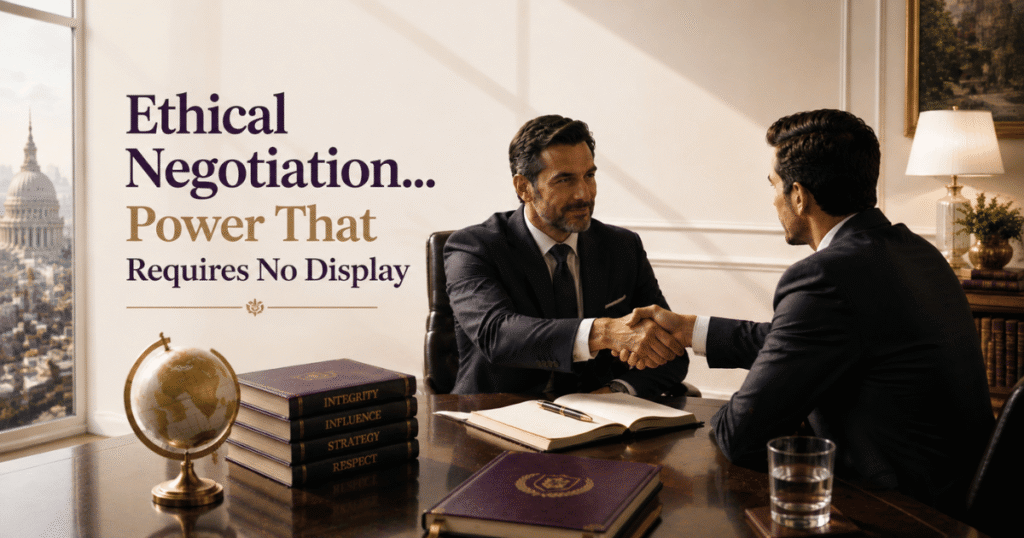
Negotiation is occasionally caricatured as a game founded upon deception or the exploitation of counterpart vulnerabilities. Practical experience, however, demonstrates that the most enduring agreements are those anchored in mutual respect, transparency, and the safeguarding of all parties’ interests.
Ethics do not weaken a negotiator; they impart a credibility that is exceptionally difficult to replicate.
A counterpart who trusts your integrity grows far more willing to forge long-term partnerships, even when interests diverge across specific details.
A Presence That Persists After the Meeting Concludes

Once meetings adjourn, words alone do not linger in memory. Feelings toward individuals endure.
Did others feel respected?
Did they encounter someone who listened before speaking?
Was their presence a source of reassurance?
These impressions determine who will receive an invitation to the subsequent meeting, and who will emerge as the touchstone during crises.
Professional standing is not forged in the moment a decision is announced, but across hundreds of minor details people experience together over time.
Conclusion
Ultimately, words are rarely what shifts the trajectory of a negotiation; it is the human being who delivers them.
Phrases may fade, but refined presence remains deeply entrenched in memory because it touches something far profounder than language.
Perhaps the greatest achievement a leader or negotiator can attain is not exiting every meeting victorious, but departing having left others with the impression that they engaged with an individual who comprehends how to balance firmness with respect, intellect with humanity, and the defense of one’s interests with the preservation of the dignity of those seated beside them.
The power that endures is never that which is imposed, but that which compels others to choose to listen.
Therefore, as you enter the negotiation room next time, ask yourself:
Have I prepared my words thoroughly?
Then pose the more critical question:
Have I prepared my presence?
Does your executive presence require strategic calibration to reflect the true value of your expertise?
We invite you to explore the “Sovereign Presence Protocol”—a specialized strategic consultancy wherein we assist you in refining your non-verbal communication skills and curating your presence to align with your leadership aspirations within major institutions.
[Click here to book your strategic diagnostic session for your leadership presence]
References
- Presence – Amy C. Cuddy.
- What Every BODY Is Saying – Joe Navarro.
- The Definitive Book of Body Language – Allan Pease and Barbara Pease.
- Silent Messages – Albert Mehrabian.
- Emotional Intelligence – Daniel Goleman.
- The Presentation of Self in Everyday Life – Erving Goffman.
- Harvard Business Review, articles on Executive Presence and non-verbal communication.
- Center for Creative Leadership, research on executive presence and leadership communication.
- MIT Sloan Management Review, articles on organizational leadership and institutional communication.