
The Golden Hour: What to Do in the First 60 Minutes of a Crisis?
In institutional leadership, crises are rarely defined solely by the event itself. They are defined by the quality of judgment exercised while information remains incomplete, pressure is rising, and the organization is still attempting to understand what has happened. Pearson and Clair describe an organizational crisis as a situation characterized by high impact, ambiguity concerning its causes and consequences, and pressure to make decisions rapidly (Pearson & Clair, 1998, p. 60). The concept of the “Golden Hour” should therefore not be interpreted literally as a sixty-minute period within which a crisis must be solved. It is better understood as the opening phase in which leadership establishes the architecture through which the institution will subsequently interpret events, allocate authority, communicate with stakeholders, and protect continuity. As Fink’s work on crisis management emphasizes, organizations that enter this period without tested preparation can find themselves overwhelmed by the rapidity and magnitude of events (Fink, 1986). The first hour is consequently not primarily a race toward an answer; it is a test of whether leadership can create order before uncertainty becomes organizational disorder.
Resist the Pressure of the Immediate Response
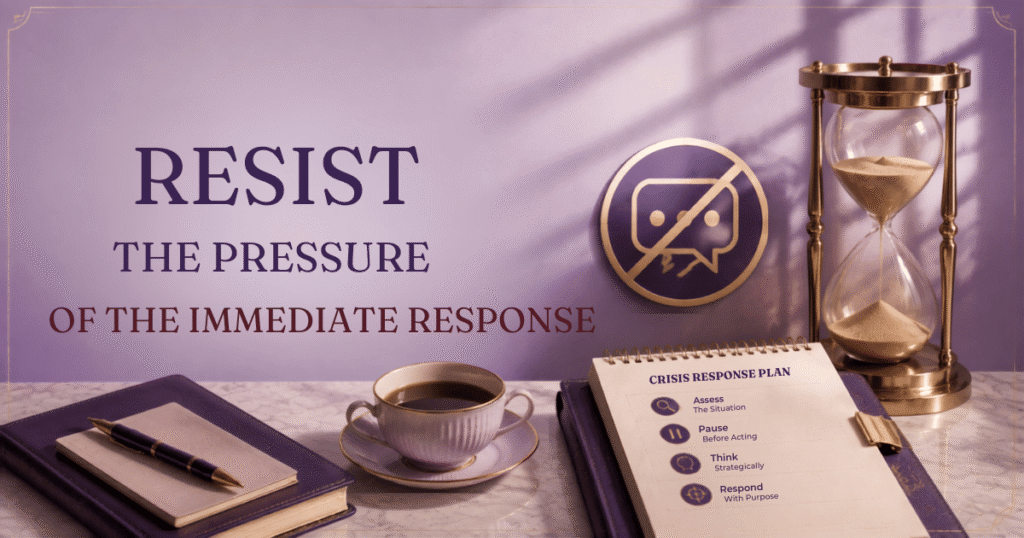
The first responsibility of an executive during a crisis is to distinguish urgency from haste. A crisis can require immediate action without justifying immediate speculation. Pearson and Clair’s multidisciplinary framework is particularly relevant here because it treats crises as phenomena in which psychological, social-political, and technological-structural dimensions interact simultaneously (Pearson & Clair, 1998). The executive who reacts to the loudest demand in the room risks allowing psychological pressure to substitute for verified information. This is especially dangerous when journalists, regulators, employees, clients, investors, or political stakeholders are demanding an explanation before the organization has established what is known.
The first operational discipline should therefore be factual differentiation. Leadership must determine what has been confirmed, what remains provisional, which consequences have materialized, who may be affected, and which assumptions are currently being treated as facts. This is consistent with the preparation and recognition stages emphasized in Coombs’s crisis-management framework, which places crisis recognition and response within a broader process rather than treating communication as an isolated activity (Coombs, 2015). The distinction is fundamental: what is known must be separated from what is assumed, and what is assumed must never be presented as established fact. A premature public statement can create a second crisis because the organization may subsequently have to retract its own interpretation.
Fink’s analysis of the Exxon crisis illustrates the consequences of inadequate preparation in the opening period. He argues that Exxon’s plans were untested and that the company consequently failed to gain the upper hand in the critical opening moments of the crisis (Fink, 1986). The lesson for executive leadership is not simply to communicate faster. It is to ensure that speed rests upon an existing capacity to establish facts, test assumptions, and make decisions under pressure.
Establish a Decision Architecture
Once the initial facts have been established, the institution must rapidly create a clear decision architecture. A crisis rarely becomes more manageable because every potentially relevant person is invited into the room. On the contrary, an uncontrolled expansion of participants can produce competing interpretations, duplicated authority, contradictory instructions, and delays precisely when clarity is most valuable. Pearson and Clair’s multidisciplinary approach is useful here because crisis management necessarily crosses psychological, social-political, and technological-structural domains; the existence of multiple legitimate perspectives therefore makes coordination more important, not less (Pearson & Clair, 1998).
The executive response should distinguish between the functions of directing, verifying, communicating, and executing. Someone must possess clear authority to establish priorities; someone must gather and validate information; someone must coordinate communication with internal and external stakeholders; and someone must monitor whether decisions are being implemented. These responsibilities may be distributed across legal, operational, communications, security, human-resources, diplomatic, and executive functions, but institutional accountability cannot be distributed so widely that nobody ultimately owns the decision. The crisis room must therefore become a decision room rather than a space for collective anxiety: information enters, assumptions are tested, priorities are established, decisions are assigned, and implementation is monitored.
This is also where the distinction between crisis management and crisis communication becomes important. Coombs conceptualizes crisis communication as strategic communication capable of either reducing or increasing the negative effects of a crisis on organizations and stakeholders, emphasizing that communicative action must be understood as part of the broader management process (Coombs, 2015). Communication cannot compensate for an absent decision architecture. A polished statement issued by an institution that does not know who is responsible for the next operational decision merely creates the appearance of control
Protect Institutional Trust

During the Golden Hour, leaders frequently become preoccupied with protecting the institution’s image, yet image and institutional trust are not identical. A temporary appearance of control can coexist with a significant deterioration in stakeholder confidence. Crisis communication research instead emphasizes the strategic relationship between organizational action, communication, attribution, and stakeholder perceptions (Coombs, 2015). The objective should therefore not be to make the organization appear omniscient, but to make its conduct credible.
This distinction becomes particularly important when information is incomplete. Stakeholders do not necessarily require an institution to possess a complete explanation immediately; they require the institution to demonstrate that it understands the difference between established information and information still under investigation. A carefully calibrated statement such as, “We are aware of the situation, are currently verifying the available information, and will communicate confirmed developments as soon as they are established,” can therefore be more authoritative than an elaborate explanation built upon unverified assumptions. It communicates presence without manufacturing certainty.
The principle is closely aligned with the broader crisis-management perspective advanced by Pearson and Clair, who argue for an integrated understanding of crises rather than a narrow communications model (Pearson & Clair, 1998). Institutional trust is constructed through the correspondence between what the organization knows, what it says, and what it does. When those three elements diverge, stakeholders begin to question not only the current response but the reliability of the institution itself.
Communicate Before the Information Vacuum Expands

Silence during a crisis is rarely interpreted as pure neutrality. In a contemporary information environment, the absence of institutional communication creates space for alternative interpretations, speculation, attribution, and competing narratives. Coombs explicitly treats timing as a significant component of crisis communication and emphasizes that crisis response involves the management of meaning, not merely the transmission of information (Coombs, 2015). The purpose of early communication is therefore not necessarily to tell the entire story. It is to establish a credible factual reference point while the investigation continues.
This requires proportionality. The first communication should address what can responsibly be established, acknowledge what remains under review, indicate what the institution is doing, and establish when further information can reasonably be expected. Ulmer, Sellnow, and Seeger’s work similarly emphasizes the role of crisis communication in moving organizations beyond immediate crisis response toward the restoration and development of organizational resilience and opportunity (Ulmer, Sellnow, & Seeger, 2019). Early communication should therefore neither dramatize uncertainty nor conceal it. Its function is to convert uncertainty into a structured process: the institution does not pretend that the crisis has been resolved but demonstrates that it is being actively and intelligently managed.
This principle is particularly important because stakeholder information does not necessarily originate from the institution itself. Research drawing on Coombs notes that “most of the information stakeholders learn about a corporation is derived from media reports” (Coombs, 2015, p. 271). The implication for executive leadership is substantial: if the institution does not establish a credible factual reference point, other actors may effectively construct the initial public interpretation on its behalf.
Preserve Cognitive Discipline Under Pressure
The Golden Hour is also a psychological test. Fear, anger, reputational anxiety, political pressure, and the desire to restore control can influence how executives interpret ambiguous information. Pearson and Clair’s multidisciplinary conception of crisis management explicitly incorporates psychological dimensions into the analysis of organizational crises, reminding leaders that crisis response cannot be reduced to technical procedures alone (Pearson & Clair, 1998). The executive therefore needs not only information, but sufficient cognitive discipline to prevent emotional intensity from becoming a substitute for judgment.
Composure should not be confused with emotional indifference. A leader can recognize the seriousness of an event while deliberately creating cognitive distance between the event and the decision. That distance permits competing interpretations to be considered, assumptions to be challenged, and second-order consequences to be examined before irreversible commitments are made. In this respect, composure becomes an operational resource rather than a personality trait. It creates the psychological space in which judgment can remain superior to impulse.
This is particularly relevant to the concept of crisis leadership because the pressure to “do something” can become itself a source of poor decision-making. The most sophisticated response may occasionally be a temporary pause designed to establish what is known before committing the institution publicly or operationally. The objective is not passivity. It is disciplined action under conditions of uncertainty.
Look Beyond the Immediate Crisis

A crisis decision must also be evaluated against its future consequences. Leaders naturally concentrate on immediate pressures: restoring operations, responding to stakeholders, controlling information, protecting employees, or preventing escalation. Yet the decision taken during the first hour may influence legal exposure, employee confidence, stakeholder relationships, reputation, and strategic positioning long after the original event has disappeared from public attention.
This longer horizon is consistent with the argument advanced by Mitroff that organizations can emerge from crises stronger when they treat crisis management as a matter of institutional learning and preparedness rather than merely emergency reaction (Mitroff, 2005). The question should therefore extend beyond What will resolve the problem now? and become What precedent are we creating? How will the decision appear six months from now? What additional information might subsequently emerge? Which relationships could be permanently altered? Would the institution remain comfortable defending the decision if the entire record were later examined?
Such questions convert crisis management from short-term damage limitation into institutional stewardship. The leader is not simply managing an event; the leader is creating the future consequences of the institution’s response to that event.
Keep the Human Dimension at the Centre

The technical architecture of crisis management can become so dominant that the human experience of the crisis disappears from executive attention. Yet organizational crises affect employees, clients, partners, regulators, communities, and other stakeholders who experience uncertainty differently and possess different levels of information and vulnerability. Pearson and Clair’s emphasis on psychological and social-political dimensions reinforces the importance of understanding crises as organizational and human phenomena rather than purely technical disruptions (Pearson & Clair, 1998).
For this reason, effective crisis leadership requires more than information management. It requires an understanding of how people experience uncertainty and how institutional conduct is interpreted by those affected. Employees may be concerned about safety or professional continuity; clients may be evaluating whether services remain dependable; partners may be assessing whether the relationship remains viable; public authorities may require precise information; and communities may be concerned about consequences extending beyond the organization itself. Communication should therefore acknowledge legitimate concerns without sacrificing precision. People evaluate institutions not only through the information they receive, but through the way they are treated while uncertainty persists.
Ulmer, Sellnow, and Seeger’s emphasis on crisis communication as a pathway from crisis toward opportunity is particularly relevant to this human dimension: effective communication can contribute not merely to immediate containment but to organizational learning and resilience (Ulmer, Sellnow, & Seeger, 2019). The Golden Hour should therefore be understood not as a purely defensive exercise but as the first opportunity to demonstrate the institutional character that will shape the organization’s subsequent recovery.
The Golden Hour as a Test of Leadership
The deeper significance of the Golden Hour lies in what it reveals about the quality of executive judgment. It is tempting to measure crisis performance through visible indicators: the speed of a statement, the number of meetings convened, the restoration of operations, or the volume of media coverage. Yet these measures reveal only the surface of crisis leadership. The more consequential question is what quality of judgment was exercised when information was incomplete, pressure was high, and the consequences of error were difficult to calculate.
Pearson and Clair’s work is particularly valuable because it rejects a narrow conception of crisis management in favour of an integrated framework incorporating psychological, social-political, and technological-structural perspectives (Pearson & Clair, 1998). Coombs similarly places crisis communication within an ongoing process encompassing preparation, recognition, response, and post-crisis concerns, rather than treating communication as an isolated public-relations event (Coombs, 2015). The implication is that the first hour cannot be separated from the institutional architecture that precedes it or the consequences that follow it.
The strongest crisis leaders therefore do not attempt to eliminate uncertainty by manufacturing premature certainty. They create order within uncertainty. They establish reliable information flows, clarify responsibility, protect institutional credibility, communicate proportionately, and maintain sufficient perspective to distinguish immediate pressure from long-term consequence. Their authority does not emerge from pretending to know everything. It emerges from demonstrating that uncertainty itself can be managed intelligently.
Conclusion
The Golden Hour is ultimately less a question of sixty minutes than a question of leadership posture. It represents the moment when an institution determines whether uncertainty will generate fragmentation or whether it will be transformed into structured action. The objective is not to resolve every dimension of the crisis within the first hour, nor to manufacture certainty where none exists. The objective is to establish the conditions under which subsequent decisions can be accurate, proportionate, defensible, and institutionally coherent.
Fink’s analysis of crisis preparedness demonstrates why the opening phase can become decisive when organizations have not sufficiently tested their plans; Pearson and Clair demonstrate why crisis management must integrate multiple organizational dimensions; Coombs establishes the importance of structured crisis communication; Mitroff emphasizes the possibility of institutional learning and resilience; and Ulmer, Sellnow, and Seeger place communication within the broader movement from crisis toward opportunity (Fink, 1986; Pearson & Clair, 1998; Coombs, 2015; Mitroff, 2005; Ulmer, Sellnow, & Seeger, 2019). The Golden Hour therefore constitutes a synthesis of executive disciplines rather than a communications tactic.
A crisis exposes the architecture beneath an institution’s visible surface. It reveals whether responsibilities are genuinely understood, whether communication reflects reality, whether leaders can preserve judgment under pressure, and whether institutional values remain intact when circumstances become difficult. The leader who can bring clarity to uncertainty, equilibrium to pressure, and direction to complexity gives the institution something more valuable than an immediate answer: a credible path forward. That is the deeper purpose of crisis leadership.
References
- Coombs, W. T. (2015). Ongoing crisis communication: Planning, managing, and responding (4th ed.). SAGE.
- Fink, S. (1986). Crisis management: Planning for the inevitable. American Management Association.
- Lerbinger, O. (2012). The crisis manager: Facing disasters, conflicts, and failures (3rd ed.). Routledge.
- Mitroff, I. I. (2005). Why some companies emerge stronger and better from a crisis: Seven essential lessons for surviving disaster. AMACOM.
- Pearson, C. M., & Clair, J. A. (1998). Reframing crisis management. Academy of Management Review, 23(1), 59–76.
- Ulmer, R. R., Sellnow, T. L., & Seeger, M. W. (2019). Effective crisis communication: Moving from crisis to opportunity (4th ed.). SAGE.